George Meacham Holaday, 1818-1895
The book, "The Colorful Life of George Meacham Holaday" will be released in July 2024! Click the link for more details and purchase links.
-------------------
To say George was an interesting character would be a great understatement. :) When I began researching his history, I hit many roadblocks, and still do today. I try to just dig deeper. J George was my third great grandfather.
I am impressed with George's accomplishments at the same time I am disappointed in his failures; namely the roaming nature of him that surely made life very difficult for his wife Lydia Hollingsworth. Lydia was a direct descendant of Valentine Hollingsworth, a founder of the Hollingsworth family in America circa 1682, in the time of William Penn. He was a prominent Quaker.
George, quite simply, could not seem to sit still. He always had his hand in something, whether it be a land purchase, a saloon or a great many other undertakings.
According to the 1894 Kern Co Voter Registration, George was 76 yrs of age, 5 ft 7.75 inches tall, light complexion, blue eyes, brown hair and blind in the left eye. I would be willing to be he was a handsome man.
~~~~~~~
George was born Oct 8, 1818 in Orange Co, IN to parents Samuel and Mary Dolly Meacham Holaday. His parents were married on March 28, 1814 in North Carolina. Circa 1817, the family made their way from Orange Co, NC to Orange Co, IN. They settled at Lick Creek and became members of the Lick Creek MM in Paoli, Orange Co, IN.
Many Quakers from North Carolina were Orange County Pioneers. In 1809 Jonathan Lindley visited Indiana Territory with a land—seeking party, and purchased land in what is now Vigo Co. In 1811, under his leadership, a party of thirty or more left North Carolina, and arrived in Indiana Territory, where they stopped at the stockade at Half Moon Spring, near Lick Creek, in what is now Orange Co. It seemed inadvisable, due to unsettled conditions, to push on to the Wabash Country, as had been planned, so they remained at the Lick Creek settlement.
In 1813, Lick Creek Monthly Meeting of Friends was set up by West Branch Quarterly Meeting of Ohio. It grew rapidly. Members were admitted to the meeting from meetings in North Carolina, Virginia, Tennessee and Ohio. ~Linda Lockhart~
George's mother, (Mary) Dolly Meacham Holaday, was a very interesting woman in her own right. She was the daughter of George Meacham and Mary Dunham of North Carolina, who were buried in the Meacham Graves; Paoli, IN. Dolly’s siblings, Isaac and Ruth (McVey) were buried in the Old Paoli Cemetery.
Meacham Graves -- From the Cemetery Records compiled by the Lost River Chapter DAR, Paoli Township Sec. 34 T. 2N.- R.1.W. Obliterated.
In a field, just west of Newberry Cemetery, are the graves of George Meacham and his wife, early settlers from North Carolina. The family lived about three miles north of Newberry, and at the time of George Meacham's death, there was a plan to open a public burying ground at this place. Only the two Meachams were buried here and it is probable that the plan was abandoned with the opening of the Friend's cemetery, a few years later. For many years the little burial plot was kept fenced by descendants, but has now been plowed over.
Isaac Meacham, a son, and Ruth McVey, a daughter, are buried in the old Paoli Cemetery.
The graves had markers of field stones, no inscriptions: MEACHAM, George, died in 1819, MEACHAM, Mary Durham, died in 1823.
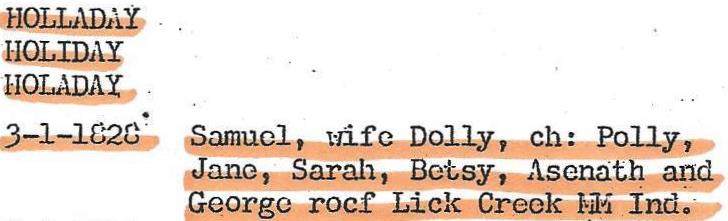
In 1828, Samuel, wife Dolly and children Polly, Jane, Sarah, Betsy, Asenath and George were received on certificate from the Lick Creek MM to the Vermilion Co, IL MM.
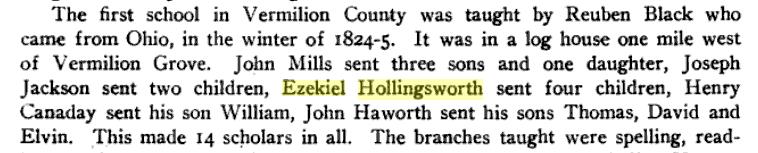
Mary Dolly became very involved in the Vermilion MM as well as visiting other Monthly Meetings. On April 1, 1837, Dolly announced her intent to marry Ezekiel Hollingsworth -- a very accomplished man in the MM's -- and! very interestingly, the father of Lydia Hollingsworth, who would later become George's wife soon after. Dolly and Ezekial married on June 3, 1837 at the Elwood MM House in Vermillion Co, IN. George and Lydia, as well as a brother of Lydia, Zebulon, were present as witnesses.
So far, no death records for Samuel Holaday have been located but there is a mention of the fact that Dolly had become a widow: (Note the error in that it says: "Orange Co, IA" rather than "IN."
 j
j
Ezekial Hollingsworth, father of Lydia and 2nd husband of Dolly, was born abt 1781 in Berkeley, SC. Ezekial's first wife, the mother of Lydia Hollingsworth, was Jane Hollingsworth; Ezekiel's first half cousin. Jane died sometime before 1837.
The following appeared in The History of Vermilion Co, IL Vol I.:
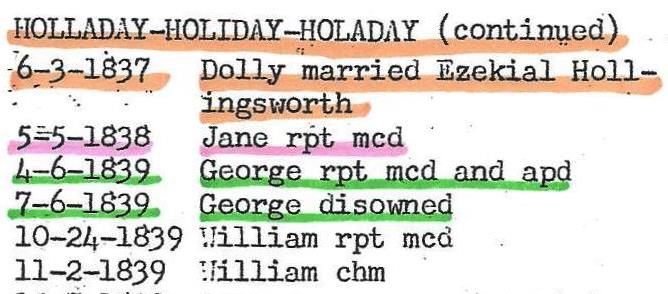
Meanwhile, unfortunately, George found himself in trouble with the Quakers. In April 1839, George was reported for "marrying contrary to discipline" and "attending places of diversion." George and Lydia had wed in a civil ceremony in Vermilion Co, IL on November 29, 1838. He did not repent and he was disowned in July 1839. This is the last mention of him in any Quaker records. George's sister Jane had also married contrary to discipline and was disowned in October 1838.
George would never have made it as a Quaker, anyway, considering his future activities. For his wife, Lydia, however, it was a hard blow. From her obituary: "Her ancestors were a Quaker family, prominent in the history of Pennsylvania, Indiana, Illinois and Iowa as pioneers and nation builders. Born in the Friends’ faith, she was the greater part of her life unable to attend a church of her belief, yet she lived always according to its truest creedal spirit, being a deep and untiring reader of the Bible, and a searcher for its hidden and inspired meanings."
On November 8, 1939, George and Lydia's first child of 11 children, Samuel, was born in Vermillion Co, IN.
Circa 1840-1842, George and Lydia made their way to Henry Co, IA. Ezekial and Dolly had received a certificate to the Salem MM in Henry Co in August 1842. According to the grand-daughter of Jeremiah Hollingsworth, Lydia's brother, the entire family made their way from Vermilion Co to Keokuk Co. The family was said to consist of Ezekial, wife Dolly and twelve children and their families. They became members of the Friends Church at Rocky Run. Ezekial's first cabin was said to be a cross between hoopcabin and Indian bark hut.
More children were born to George and Lydia: Miles, born in March 1842, and next John Milton, born 1843. An Iowa Census, 1844 lists George in Keokuk Co, IA. Caroline was born in 1845, twins Emma (Emily) and Ellen in 1846 and William in 1848. Also, an 1850 Census shows these family members as living in Keokuk Co.: George M, Lydia, Samuel, Miles, John Milton, Caroline, Emily, Ellen, William.
Ezekial Hollingsworth, Lydia's father, died sometime before 1845, as we find Dolly remarrying on November 13, 1845 to Mahlon Stephenson Sr at the Bloomfield/Bloomingdale MM in Park Co, IN. What a sad thing for her that her 3rd husband died soon after, on January 15, 1846. Dolly suffered through the deaths of three husbands. I have lost track of Dolly beyond this time.
1850 began George's wanderlust time and he went westward for several years. He hardly sat still again until 1880. He seemed to appear only long enough to make more children, and he was off and running again.
George must have been a man that exuded some power, charisma, charm. He surely did, for he found himself in positions of power and command in spite of being a disowned Quaker with no formal education.
While acting as county judge, along with D.M. Valentine, the county surveyor, and Abram Rutt, the town of Fontanelle, IA was laid out. George established the Holaday Post Office in northeast Adair Co and operated it from 1855-1856 or so. George sowed the first wheat in 1854. The first oats were sown by George and John Febus in the spring of 1854; the former on Section 35 and the latter on Section 27.
George performed the first marriage in the county on May 7, 1854 at the residence of William Alcorn, between William Stinson and Elizabeth F. Crow.
The first election was held at the house of George Holaday on Section 35 in 1855.
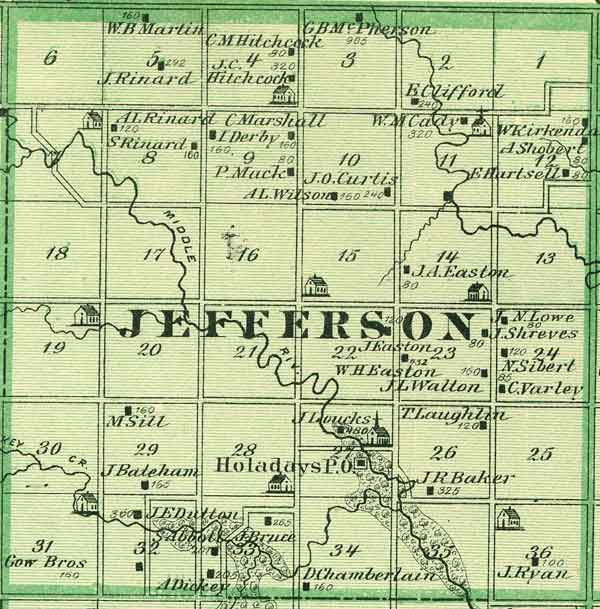
George and Lydia's next child was the first birth in Jefferson Township. Thomas Jefferson Holaday was born in the fall of 1854, but unfortunately died the following year, in the autumn of 1855. He is said to be buried in a pasture in Section 26 of Jefferson Township. He was buried with another child, William Alcorn, who was 7 or 8 years old when he died in 1853 of a rattlesnake bite. William was the first death in the county.
The next child appears to be Orpha Holaday, born about 1856. Pauline, the next child, was born on June 19, 1856.
From Lydia's Obituary: "Of the eleven children born to Mrs. Holaday two died in infancy..." These two children are Thomas Jefferson and Orpha.
Sometime also circa 1856, George was off and running again, this time to Ft. Des Moines, IA, supposedly to educate his children. Lydia was said to be agreeable to this. A write up in the History of Guthrie and Adair Counties, IA, 1884, transcribed by Bobbi Pohl, states: "In the fall of 1856 he left here for Des Moines, wither he went to educate his children. He did not turn out well, leaving his wife and children to shift for themselves, and left this country with another woman. He is believed to be in California at the present time....."
While at Ft Des Moines, George was a Justice of the Peace from 1857-1858.
In 1859 George returned to Winterset and apparently got busy right away and his last child, Henry Delano, was born on April 10, 1860. In 1856, Judge Pitzer built a hotel in Winterset, which was initially named "Pitzer House." George and Lydia appear in Winterset circa 1859 and sometime soon after their arrival, they were running the hotel, which had been renamed, "The St Nicholas." Lydia would later run the hotel by herself for a time.
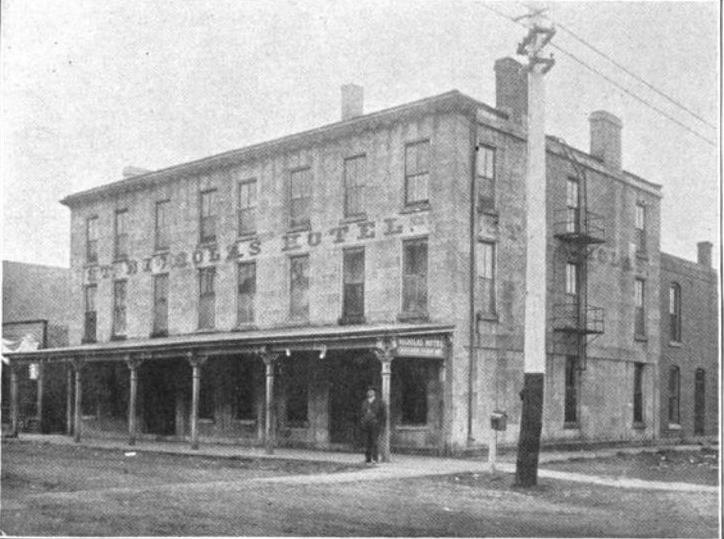
George and Lydia's daughter Caroline, in a 1908 writing referred to the St Nicholas as a "tavern." An excerpt from her writing:
"It will be hard for this and future generations to realize our almost primitive modes of living -- our facilities for news and transportation were very different from what they are now, instead of taking our much abused train for Des Moines, a stage coach was drawn up in front of the St Nichols Hotel (then the "Pitzer House" and always spoken of as a tavern) each morning for passengers. It also carried the mails, and its return in the evening was watched for with great interest.
The pride of those stage drivers in making a rapid, entry, and the peculiar crack and wielding of their whips and the masterful way of rounding corners was something only attained by long experience. Then they were also news carriers, anything that had happened in the outside world since they had left in the morning was quickly told, and, eagerly listened to by the many by-standers who had congregated to witness the grand entry and hear the latest news."
George's presence did not last long. He left in 1860 on a mining expedition to Pike's Peak. It is said he was involved in running a freight line between Omaha, NE and Denver, CO for a few years.
In 1864, an Arizona Census shows George in Arizona Co, La Paz township. While here, he was a member of the House of Representatives in the 1st Arizona Territorial Legislature. How, oh how, did George obtain such a position one must wonder! He is listed as: George M. Holaday, La Paz, AZ, Hotel Keeper, 46 years of age, born in Indiana.
By 1867, George was moving on, this time to Sonoma Co, CA, where he kept a hotel and bar for six months.
In 1868, George is in Orange Co, CA and was a Justice of the Peace for several terms.
Also in 1868, George marries again. I do not believe George ever divorced Lydia; he simply left Lydia.
In 1872 George was buying up land in Rancho Las Bolsas tract. It included Fountain Valley, CA and is present day Orange Co, CA. In 1879 he purchased a ranch in the tract of the Westminster colony, Westminster, CA, which is present day Orange Co also.
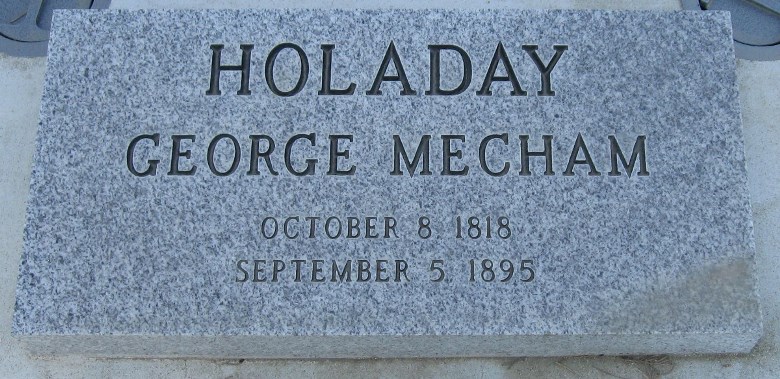
George died in Tulare, CA on September 5, 1895. George is buried in the Tulare City Cemetery. Note the misspelling of his middle name - (his mother's maiden name.)
Back in Iowa, Lydia remained in Winterset for her entire life. Her husband left her just before the Civil War broke out, and it is unimaginable what it must have been like for her, to raise her children with no assistance in the middle of war times.
George & Lydia's daughter Caroline wrote a beautiful piece in 1908 about life during Civil War times in Madison County. An exceptionally beautiful passage:
"My paper today will treat of conditions here in Madison County, where I fear there were not many Spartan mothers who buckled on the armor and bade their sons go forth and battle for their country. No, the mothers of whom I have knowledge although noble and patriotic, held these boys tenderly to their hearts, while the tears blinded their eyes, and the sobs followed those boys as they marched bravely away in their new uniforms.
Their tears must soon be dried and their attention turned to the practical things of life, the crops must be raised, the affairs of everyday life must be attended to, as many of the men left at home were too old, and others too young to enlist, the women had to assist in the outside work, but I never heard any complaining, they did what they could..."
I have read this passage repeatedly. Any mother of any child in danger's way would be able to relate to this -- it is truly timeless.
Lydia lived with her daughter Caroline for many years after Caroline's husband, Benjamin Franklin Murray, died 1890.
Cemetery records indicate "senility" as the cause of death.
I have immense respect for Lydia. She endured great hardships and did so alone for so many of her years.
As I research, Lydia is always on my mind, as is her baby daughter Orpha, in particular. Although she was born more than 150 years before me, she is alive in my heart and soul. This page, really, is more about Lydia than her husband George, in many respects. I want to honor her, her hardships and trials.
As I type this now, on my Windows 7 computer and prepare to put it on the Internet in 2013, I think of Caroline's closing comments in her piece....
"It is probably difficult for our "youngsters" of today to see in this Company of the Grand Army of the Republic - young, active, enthusiastic, vigorous young soldiers of '61 and '65."
...and I wish there was a way to say to her -- "Yes, it is difficult, but more than a century later, we are reading your eloquent words and we are exceedingly grateful that you put them to paper and... we... truly and deeply care."
RIP.